

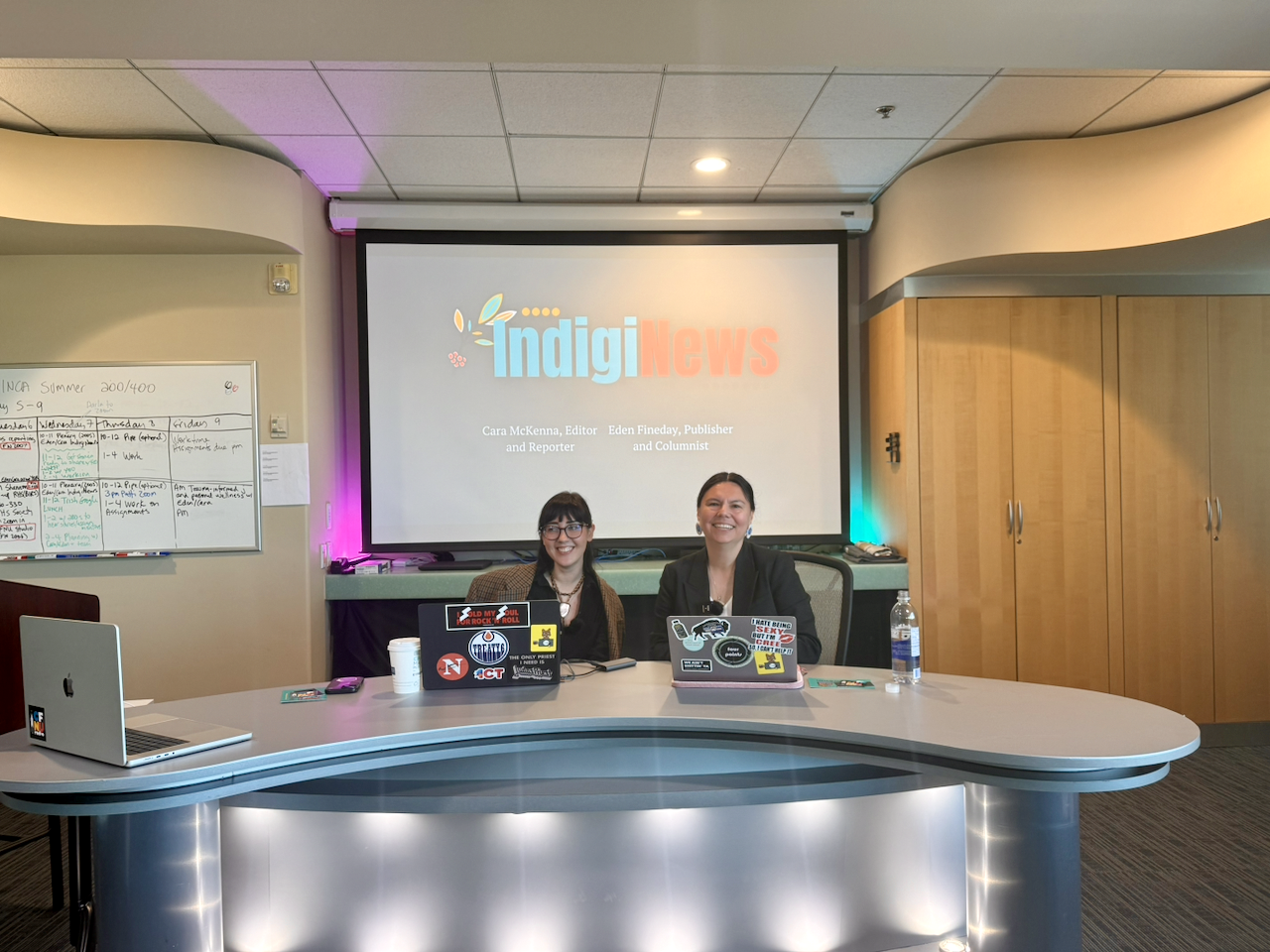
Eden Fineday leads tâpwêwin media, a national Indigenous media nonprofit in Canada. Within tâpwêwin, IndigiNews is a newsroom committed to strengthening reporting on Indigenous issues. The concept of tâpwêwin is important in Cree (nêhiyaw) culture, Eden tells me: “It is about integrity, witnessing, honesty and being reliable about your testimony, about what you saw.” Cree is one of the largest and most widespread Indigenous peoples in North America.
According to a 2024 survey from the Canadian Association of Journalists (CAJ), about 3.5% of the country’s journalists identify as Indigenous. The 2021 Canadian census found that Indigenous people made up approximately 5% of the country’s total population.
Excerpts from our conversation follow.
The meaning of tâpwêwin sounds like the values of ethical journalism.
Yes, IndigiNews is pretty traditional hard news. We do report on communities, with their culture, language, and beautiful things, but the way it’s done is through very traditional journalism. I think journalism is storytelling, and reporting is something that Indigenous people have always done, because that’s how we survived, right? We would have scouts that went ahead, see what was happening, go back, and report to the rest of the band or tribe what was going on. In Canada, we call it a band; in the United States, they call it a tribe. It’s about transmitting information so that the community can be informed.
The way that journalism has evolved over the years is not always in line anymore with the values you mentioned.
I don’t know if there ever was a “good old days” of journalism for the Indigenous people. Journalism has always been biased against us. Mainstream journalism was completely racist. For the first hundred or so years of reporting on Indigenous people, they would either completely misunderstand the situation, only focus on the negative, or just ignore the situation.
Things are changing. Everything is fragmented now. There are a few big newspapers left, but the rest is precarious. The Indigenous people are used to that: our entire existence has been in the margins, with very little money. We’re good at thriving in precarious times, because those are the only times we’ve known for the last 500 years.
What are the biggest lessons for journalism from you now, in this fragmented landscape?
It’s almost like we’re in this stage where something is gonna come, but we don’t know what it is yet. Maybe something new will emerge, and maybe journalism will either become a different animal, something that’s way more collaborative and much more government-funded. A drastically different funding model is needed to survive.
In Canada, Google and Meta collectively control roughly 80% of all online ad revenue. They have completely decimated the Canadian news ecosystem. For two or three years now, Meta has also banned all news from its platforms, so we can’t even post on Facebook. We can boost ads, but our page is invisible. We spend like $15,000 to $20,000 a year on boosted ads on Facebook. Half of our page views come from there. That’s where Native people are, in Canada at least.
Subscriptions never covered the whole cost of the production of a newspaper. The federal government funding program called the Local Journalism Initiative is ending in 2027. It was set to be five years, then they extended it another two years. The question is what the government is going to do next year. If they stop funding journalism, half of every outlet will either collapse or become drastically smaller. Since the beginning, all of our reporting positions have been funded by the Local Journalism Initiative.
What does your financial sustainability look like?
It’s all charity from family foundations, public foundations, and federal funding programs. I’m always hustling, running around, meeting people, and explaining to them what we do. It’s like everything’s crumbling, and there’s a flower growing out the broken concrete, and that’s us.
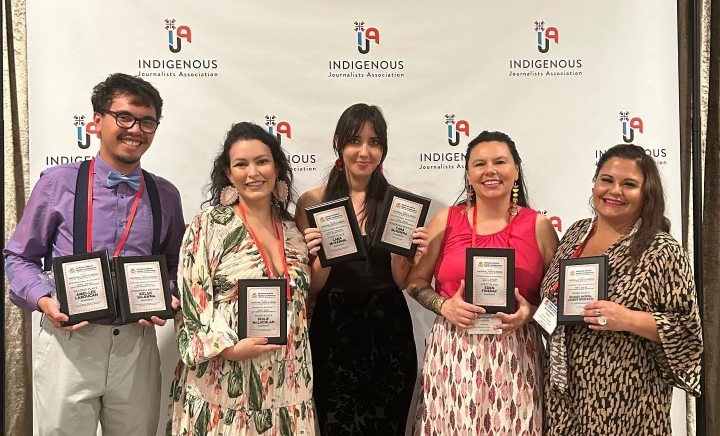
We’re so tiny that we’ve sort of managed to evade all of the bigger catastrophes for six years now, and our record is good. We’ve won or been finalists for a ton of awards, going up against all of the major newsrooms in the country. Our journalism is respected, and now we can look back and we have a bit of a legacy. It’s really cool that we’ve made it this far.
Where do you distinguish yourself in your work?
It’s the method of how we operate. One of the cultural teachings that I’ve received from an Elder is about that. He said to me a few years ago, “how you do something is more important than what you do.”
It’s a pretty radical thing to say. We live in a world in which the opposite is true. We don’t care how you get it done—get it done. We don’t care how many species need to go extinct, we’re mining to get that gold out. It’s all about the “what” in this world. In my culture, the values are the opposite, and that’s how I run this organization.
The world is so harsh, and I think of this as being a traditional storytelling lodge: a safe place where people can relax, have cultural safety, and can let their guards down. I’m here trying to protect the lodge, get some funding for it, and make sure it doesn’t become destroyed by the world around it.
I don’t wish any ill will on any other news organizations. I hope they make it. It’s a tough time, and I meet a lot of incredible, generous and kind journalists across the country.
What role does your Firekeepers campaign play in your sustainability?
Our Firekeepers program is for the individual donor. We have about 500 people who donate small amounts monthly. It is a significant amount of our annual budget, and so I consider them fire keepers. The campaign was an idea that came together in five minutes. It felt right, because a traditional storytelling lodge always has a fire in the middle.
tâpwêwin media just finished its first Refocus Photojournalism Fellowship. How much of what you’re doing with the fellowship is about building an institution, more than just a media organization?
We got funding specifically to co-create that program over the course of a year. We had nine people in the cohort and spent seven days on the ground together in Halifax with four instructors who are professional photojournalists and Indigenous. It was incredible. The plan is to do it every year, with improvements in how we set it up.
My dreams are like a universe. We love big dreams. I want to see way more Indigenous youth being trained in how to tell the stories of their communities where they live, whether that be on reserve or in cities. I want to see much more engagement from Indigenous people generally in sharing stories. I envision a wire, where all the hundreds of First Nation reserves in Canada are connected. The people are now getting their information on Facebook, but what if Facebook gets “Musked”? The algorithm is already changing and we have no control of the platforms. What if we could create something that was actually from us, for us, by us?
At journalism conferences, Indigenous media is often approached separately, whereas you could say that Indigenous values are the foundation of good journalism. What is your take on that?
I laugh, because I truly believe that Indigenous culture is the solution to every problem that the world is facing right now. I know that sounds really arrogant; I don’t mean it to be, but from what I know about my culture, it’s just so stunningly beautiful. There’s so much compassion and wisdom, and the care that we traditionally used to put towards our children and our Elders.
The worldview is so drastically different, and I just personally think it’s a more beautiful worldview, based on the idea of reciprocity and balance. We would never have a society where we’re just destroying the earth as fast as we can for money. What I think is hilarious is that a lot of non-Indigenous people believe that we were just too dumb to build buildings, or we were like animals living in the forest. They don’t understand that the forests were there because we stewarded them for 40,000 years. We worked and lived within those ecosystems in a very wise way.
It wasn’t that we were like children or underdeveloped adults that needed support. We had a totally different worldview in which we had relationships with the trees and the mountains, the stones, the rivers. They were literal and are, I believe, relatives of ours. That’s just a saner way of living. I would love it if Indigenous ways of doing journalism could be integrated more broadly into journalism. I think, though, that the need to make a profit would really cut up against the way we do things. Because what we have to do, in order to do things in a good way, that kind, good, caring way, is that we can’t rush. We also can’t make demands.
I really do believe that cultural sharing is what the world needs right now, between all of the people.
What are the biggest challenges for you in building the universe you envision?
I think it’s always going to be the funding. There’s always uncertainty; we had to become comfortable with precarity. For IndigiNews, we have funding this year, we have a few multi-year grants, so we’re probably fine for the next two and a half years, but what happens after that?
I don’t think there is a business model anymore. I feel very optimistic, because I keep meeting these other Indigenous people who have the exact same vision as I do, from Indigenous broadcasters I met last week, to the Indigenous Media Association of Canada that I co-founded.
An Indigenous universe with youth training embedded in community journalism because many of the Indigenous broadcasters are worried about nobody being out there to take over their role. I want a world in which the senior broadcasters, the legends with almost 40 years of experience, are put in rooms with young people and share their knowledge, and the young people can share the news of their community, share their culture, stories and language. Some of our younger reporters should become newspreneurs or news influencers and do their thing on TikTok. It will benefit IndigiNews and their own careers as well.