
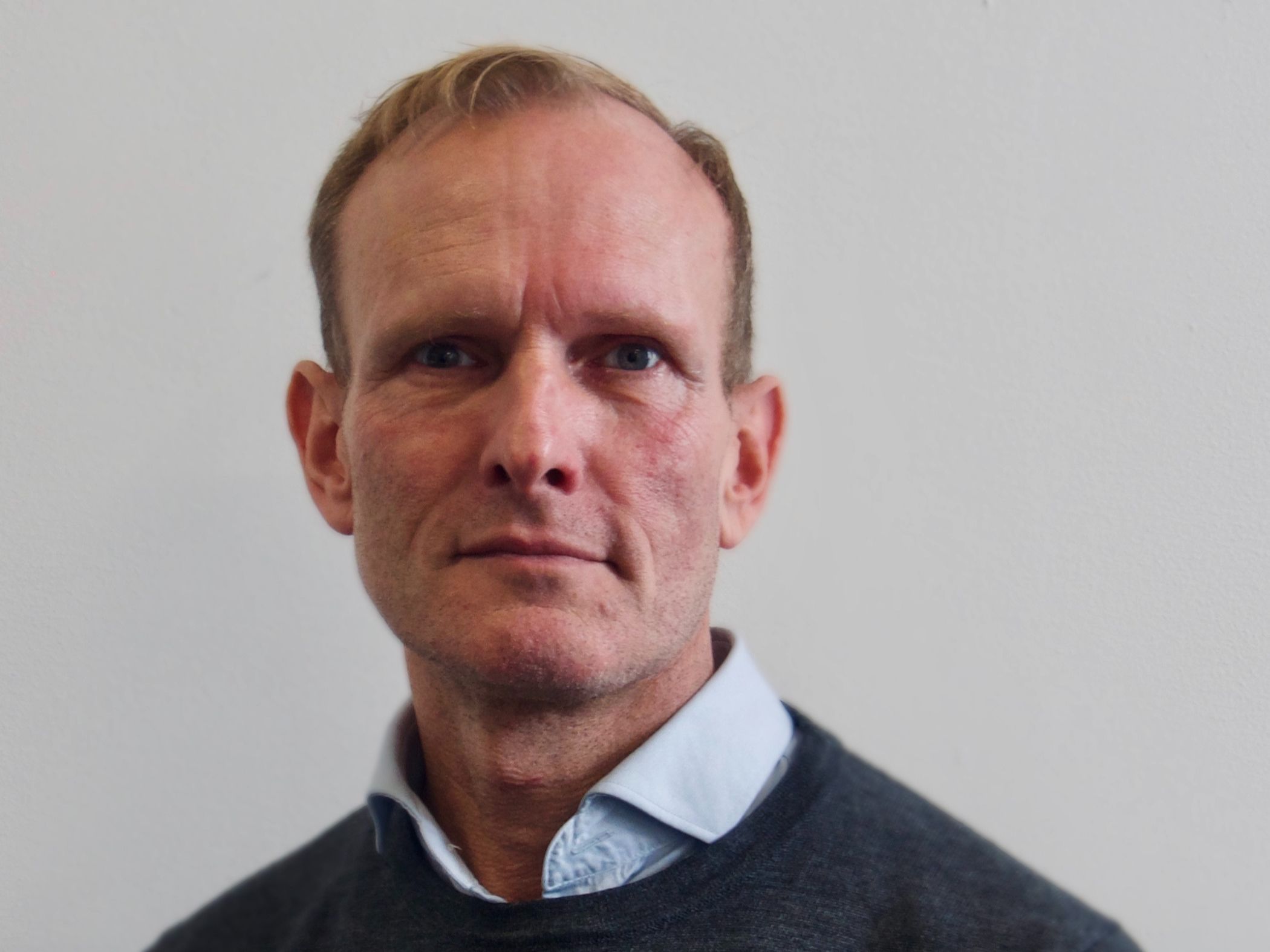
Thomas Hedin always wanted to work in journalism, but initially graduated with a business degree from Copenhagen Business University (CBS). A job in news radio lured him into the media industry, where he still works almost 30 years later. After working in public broadcasting doing radio, television, and then everything when online media came into play, he switched to the commercial political online outlet Monday Morning/Altinget in 2016 and became one of the initiators of the Danish fact-checking organization Tjekdet.
I spoke to Thomas recently (via Zoom). Excerpts follow.
Interview requests and calls for fact-checking expertise have gone up since the Israel-Hamas war started on Oct. 7. Is this war different from other conflicts?
It has far more impact than when Russia invaded Ukraine because this conflict has been going on for many years, and is deeply polarized—so the debate took off immediately. Not overnight, but over an hour, whereas in the Russia-Ukraine war, there was a shock at first and views were established slowly. When Tjekdet started seven years ago, we fact-checked other media outlets to raise awareness about mis- and disinformation. Today, fact-checking is institutionalized within the media, and it shows how important facts are. The Israel-Hamas war shows that even though you are an experienced journalist, you need to be critical of your assumptions based on your experience. With our biases and the lack of representation in media, fact-checking becomes even more important. Objectivity, transparency, and fairness are crucial in this conflict, and calling yourself an activist—as some fact-checkers in various countries outside Europe do—is not trustworthy.
Why is it important for you to see yourself as a journalist?
I knew from the beginning that fact-checking should be done in a journalistic context. It has helped us that Tjekdet was ‘born’ within the journalism industry, because it was easier to establish trustworthiness and do business. When Tjekdet was founded, we were backed by the HR department and the CEO of Monday Morning. If we had to start as an independent initiative ourselves, we wouldn’t have had a fast start. Besides that, in Denmark, we have a media fund for journalistic innovation. When everyone talked about “fake news” in 2016, it was easy for us to raise funds.
Where did the idea for Tjekdet come from?
Tjekdet started coincidentally, over lunch in August 2016, when we discussed how conversations on social media were getting less constructive and harsher. My news editor at that time, Lisbeth Knudsen, who is still on the board of Tjekdet and is a well-known figure in the Danish media industry, wondered what we could do about it. I already observed a worldwide trend of niche fact-checking initiatives and we decided to start one ourselves. Two months later, Tjekdet was created, and in November 2016 the US elections caused the momentum for us to start publishing.
We quickly gained attention within the media industry. We realized that without a doubt, we could play a role in the fake news debate. Back then, fake news and misinformation were covered by other media companies as ‘trend’ stories and not so much as journalistic content. We took on that role because we expected it to develop into a bigger problem. And our focus on misinformation, especially on social media, was uncharted territory back then among Danish media.
Since then, misinformation and disinformation have become much bigger issues, more widespread and sophisticated, with Artificial Intelligence, deepfakes, and so on. Much more than I expected. Media coverage has increased, too, but not with the same knowledge and insights we as niche media have.
Over the last two years, we have often been invited to contribute to articles and conferences, almost like experts. But we don’t have the academic knowledge; we have the practical knowledge. I like to say we are a knowledge bank.

Capture of Tjekdet website
What is your business model?
When the country shut down due to coronavirus in March 2020, the commercial news outlet that started Tjekdet cut it down to focus exclusively on its political niche. Tjekdet was never a cash cow, but didn’t have a deficit, either; it was good for branding. The founder of Tjekdet had stepped down as editor at the news media and wanted to save Tjekdet. She has held high positions in national broadcasting, and is still going strong at the age of 70. She is knowledgeable and active in the public debate [on] AI, innovation, digital media, media literacy, and how platforms affect young people. With her commitment to raising funds, we sustained ourselves for 2.5 years and as of last summer (2023), we are subject to the Public Service Media Act in Denmark. A mix of public and private funds will give us stability for the next four years.
What is your main focus?
We prioritize and convey stories that are relevant to Danes’ everyday life and insight into their role as participants in the democratic debate. We do fact-checking but also raise awareness about mis- and disinformation trends, create educational material, and participate in research projects with universities. The fact-checking part is our engine, the motor of our work. The two primary sources for our fact checks are the decision makers, such as the politicians in parliament, who we keep an eye on as the typical way of doing journalism—and what is going viral on social media. Through the latter, we receive claims directly from the audience, such as bad health advice that continues to spread online.
How has the fact-checking developed since Tjekdet started?
The need for a journalistic approach to fight mis- and disinformation has developed over the years into a greater task than expected. We are in a battle that I did not foresee, and have gone from speaking about fake news to addressing misinformation. We are involved in academic research. To my surprise, I’m running around in the European Union policy environment. The EU bureaucracy is very different from a regular job in the newsroom, but equally interesting. Media literacy projects are sprouting up as we speak and it has all grown into quite an industry. There is a lack of focused educational materials on fact-checking, though. That’s why we joined the Nordic University to make material on fact-checking. Without journalism as a backbone, fact-checking won’t survive.
You learned journalism on the job. How beneficial was your business background in your career?
My business degree was useful as Tjekdet came to life. My first editor-in-chief, almost 30 years ago, said, “You don’t need to go to journalism school. You can learn everything here.” She was right. I was always the first to jump on new technologies, and with Tjekdet we just hired an OSINT expert who wasn’t a journalist either. We will meld fact-checking and Open Source Intelligence (OSINT) techniques more together in the future. One month before the Israel-Hamas war, I advertised for such an expert, and received an application from a music industry engineer with a background in information science. He had taught himself OSINT in his spare time and always wanted to work in journalism. When he applied, I thought, “He is like me, and he needs a chance in the news industry!” He quickly learned how the newsroom functions and was given a lot of work to train other journalists in these techniques.
The spreading of images and videos that were put in the wrong context is much heavier than during the pandemic or the Ukraine war. In one of the first videos he investigated, he noticed there was something wrong with the sound. The sound didn’t match the space the person in the video was in, and he found that it was coming from another TikTok video. His musical background helped him with that.