

El Surtidor, commonly known as El Surti, was founded in 2016 as a Facebook page by a group of designers, reporters, and illustrators, out of the legacy of the student movement in Paraguay. It experienced rapid development in the years since: it grew into a proper media outlet, developed various products, and spearheaded new initiatives and even organizations that work in Paraguay and across the continent. El Surti has also become recognized as a benchmark of visual journalism in Latin America.
In the beginning, they noticed that no other media organizations were speaking to young audiences, and decided to try to reach them with new visual formats. “We saw an opportunity in graphic journalism to reach younger audiences—to mix our original reporting with a way of communicating that we felt would be much more effective at reaching young people, in a language that they can relate to,” says co-founder Jazmín Acuña. “We used the power of graphics, visuals, memes, images from movies, comics, books… and packed all of that into JPEG files. We also tested videos, scrolling and other formats, but always with our signature mark, which was graphic journalism.”
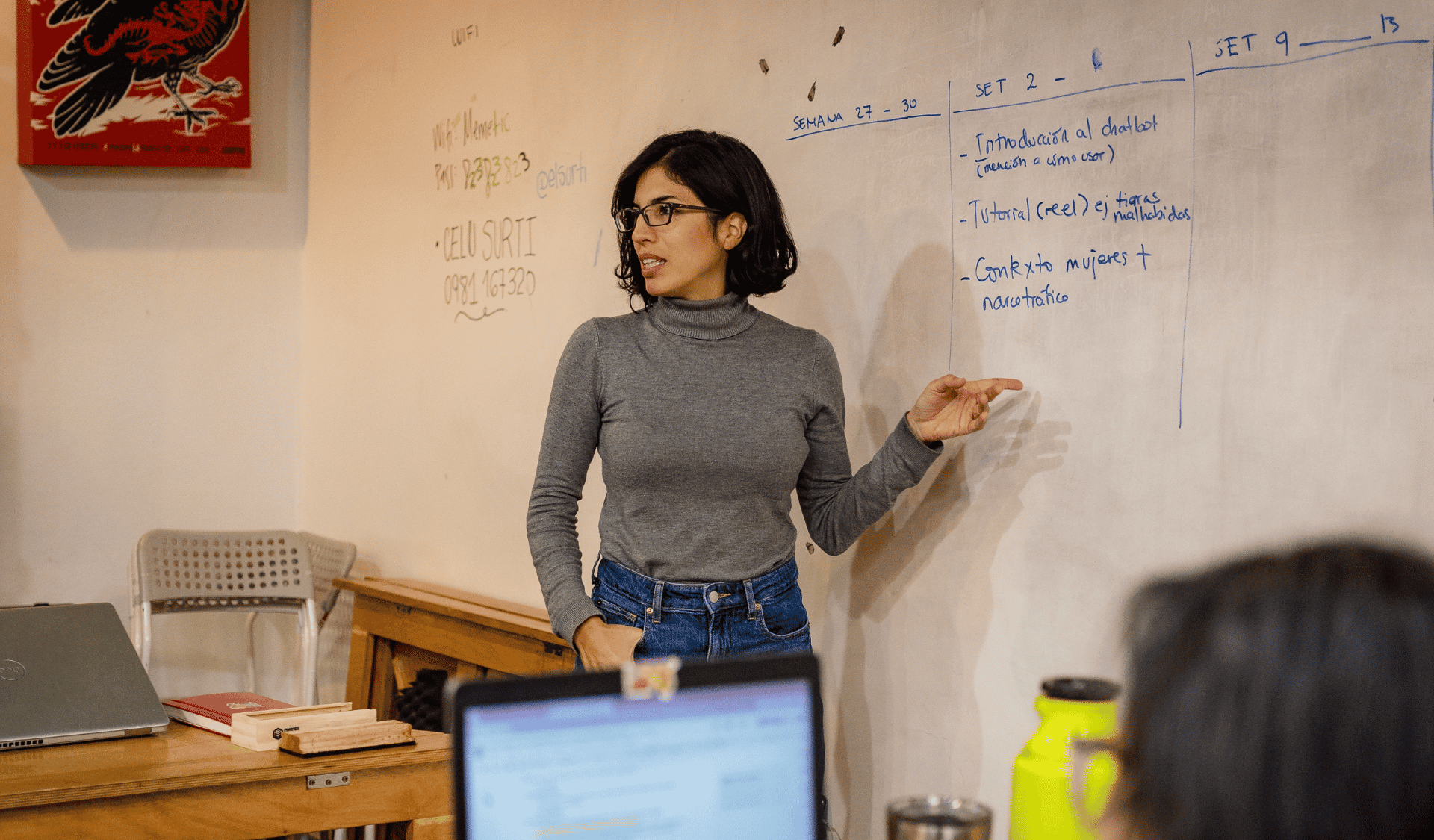
When preparing stories, El Surti’s designers and illustrators share the same room with reporters during editorial meetings and take part in the editorial process. In 2021, El Surti ran a story called Los invasores VIP del Paraguay (Paraguay’s VIP Invaders) about a land grab during the dictatorship of Alfredo Stroessner. A total of 3,000 families in Paraguay benefited from their closeness to the regime and stole land the size of Panama, which should have gone to campesino workers as part of agrarian reform. El Surti published the names of the families along with graphics.
“We worked very closely with the visual team,” Acuña explains. “They went through the original sources. They studied how land conflict has been portrayed in images in Paraguay. And then they came up with their own idea or representation of how that conflict had played out. And if you look at the images, there’s a mixture of faces of people from the dictatorship who benefited and maps of illegal land grabbing, mixed with the map of Paraguay. So, it’s like their faces materialized across the land.”
While being audience-oriented from the start, El Surti has recently been developing a new methodology to improve and increase the impact of their stories beyond the screen. As Acuña puts it, they ask themselves: “What’s the best-case scenario that will play out, or could play out. when we publish the story?” That pushed them to think outside the box: “We’re good at grabbing people’s attention, but that doesn’t necessarily always translate to action, the kind of action that you want to see. What we have tried in the past couple of years is to facilitate spaces where we can speak with our audience, especially those who could be really interested in our stories.
“For instance, we published a story about the proliferation of gas stations in Paraguay. We decided to partner with an organization that works on urban issues, and we convened a gathering with people all across the board who could be interested in that story: environmental activists, residents who were affected by the proliferation of gas stations, academics, journalists, and even people from the municipality of Asunción. And we had a sort of town hall meeting where journalists told the story. They shared the sources and findings.
“An amazing dialogue ensued in that meeting. And after that meeting, so many things happened. A new organization of neighbors was formed that now protests the proliferation of gas stations. The president and the minister of environment banned the proliferation of gas stations 1.5 years after we published the story. And we can say, with a lot of confidence, that that in-person meeting that we convened and organized was the catalyst of a lot of change.”
But this is a conscious effort. There is even a person in the team responsible for community and impact.
“We see ourselves as reporters and a newsroom that can activate civic spaces,” Jazmín says. “And it’s not about us going and protesting the proliferation of gas stations. It’s about delivering the information in a setting that will stimulate people to get organized. It’s not about us telling them to get organized; it’s something that came out of them. But that setting had the kind of thing, I guess, that leads to trust. Actually, one person in the meeting raised his hand and told us, ‘You gave us the information, now it’s on us to turn it into action.’ That’s exactly what we want to do.”
El Surti’s latest project, “I Was Arrested,” involves a chatbot called Eva, built in-house, that tells a story about women incarcerated for drug trafficking. The project has already attracted lots of interest.

“We wanted to tell the story of a woman who’s in jail due to drug trafficking, from a different angle—one that humanizes that woman, or all the women that are in jail because of drug trafficking. Their stories are much more complex than just a black and white sort of story. And we wanted the audience to have an opportunity to talk directly to the woman. The chatbot was built mainly on one interview with one woman, though the reporter did more than 10 interviews with 10 different women. And if you go there and you talk to her and you ask her questions, she’s going to reply with the original answers. We feel that the experience is one where the user can talk to a woman who they wouldn’t otherwise be able to.”
With this project, they also wanted to try new technologies, but in a different way: “We wanted to test how these new technologies can serve the way we transmit journalism instead of testing these new AI technologies to produce content. We don’t want to do that, because we don’t want to replace the work that we do pretty well and that we want to keep doing. So, we were wondering, how is it that we can use these technologies? And that’s what we came up with. It felt ethical, and it felt good. It’s technology that’s empowering our work instead of us being without work.”
El Surti’s sustainability model has changed throughout its almost nine years of existence. In the beginning, they depended on a few larger funding sources, and then they tried to diversify in order to gain greater independence.
“Something that changed the whole game, for sure, is our communications and storytelling studio,” Acuña explains, referring to Surti’s Fábrica Memética. We knew that we were missing a big opportunity when people came to us and they wanted to have the kind of graphics that we have for their campaigns, but we couldn’t do it because we were busy doing our journalism. Establishing that separate team and unit allowed us to provide a service that communities, organizations, and individuals around us need. That’s now an important part of our sustainability model.”
But sustainability for El Surti means not only the sustainability of the media organization, but also of their journalistic work: “Before, we were very worried about being on social media. That meant being there every day and two times a day or whatever our energies allow us to produce. And then we noticed that yes, we reach people with that, but we are also feeding the algorithm. And we don’t want to be that kind of news outlet. So, we started looking for ways to take care of the team, take care of reporters. We don’t want them to be burned out.
“We decided to slow down production in order to make better stories, and to do more in-depth investigative reporting that has more impact. That’s also a huge part of the sustainability model that we have. And so far, it has worked. We also put a lot of effort into giving our reporters, our designers and illustrators time off. We know that it’s worth it, that we’re taking care of our health and the health of our journalism as well.”