

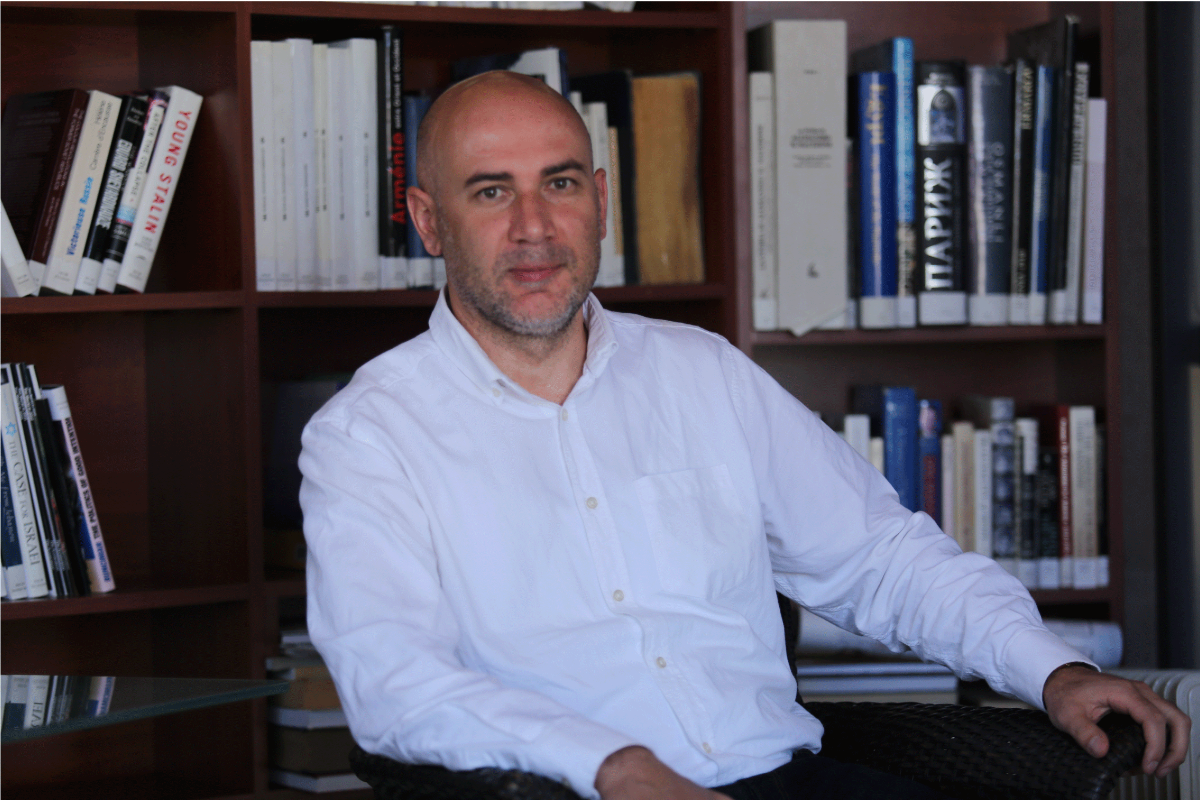
Karen Harutyunyan, CivilNet’s editor-in-chief, has been a media leader for decades. We met at the Tvapatum conference in Yerevan, earlier this year. I was there to present internal policies as developed by the media organizations in the Project Oasis directory; I planned to talk about CivilNet as a leading case study, only to realize that CivilNet’s editor-in-chief would be sitting and co-presenting right next to me. We laughed about that, and Karen also made a joke about policies better looking on paper then in practice. I started reading CivilNet’s English-language edition upon returning home, proving that those internal policies were not just a dead letter.
I spoke with Karen recently to learn more about his organization. Excerpts follow, edited for clarity.
CivilNet has pushed the boundaries of local media space ever since its establishment in 2011. In relation to editorial strategy, what was novel about your organization’s contributions to Armenian media?
We were the first to introduce live streaming of political events and street protests; we were also the first to introduce fact-based, research-based, but easily rendered content. We also tried to bring new people into our newsroom, into our coverage, because the existing media was somewhat restricted to government and politically affiliated media outlets. This was the first time that a media outlet gave such exposure to civil society actors, activists, and different sorts of movements—from environmental street protests, to the Velvet Revolution in 2018 [a series of anti-government protests in Armenia], to the 2020 war [The Second Nagorno-Karabakh War].
We’ve been covering all of this for 13 years. Most importantly, we brought a new style of video production, and that was sort of pioneering.
You publish content in four different languages. Was it like this from the start?
No. At the beginning, we were publishing only in Armenian and English. Later on, especially after the 2020 war, we started to do more coverage in Russian, because there was demand out there. Although the production in Russian is not commensurate with what we produce in Armenian or English, we now have a huge Russian audience.
Most recently, we started a French section. Although we used to do French reporting infrequently, we now do it on a regular basis, covering lots of different stories that could be of interest to international audiences, the French-Armenian community, and others.
So the content is not the same across all languages? Do you have separate teams for each language? How do you organize this?
No, the content is not the same. It’s not a simple replication. We have four separate pages, so the content in Armenian doesn’t replicate the content in English. These are totally independent. Of course, there are certain topics that are important for everybody, but in general, there are separate sites, separate pages. For example, for the English audience, you choose content that is of interest to the specific audiences, both in Armenia and outside. We also target the Armenian diaspora in the United States and elsewhere.
For English, we have a separate team. For Russian, it is not completely separate. Part of the team is bilingual, so they do both, Armenian and Russian. We have lots of native-speaking staff in our English section, including Americans and Brits, and our English-language editors are based in Los Angeles. So especially when it comes to the English language content, we reach out to the diaspora communities: presenting news about Armenia and Armenians, and trying to explain what is happening in Armenia.
What we give as an added value is not just the news, but also the context. That’s important. Unfortunately, in the Armenian media, you don’t have the proper packaging of the news. We do that packaging, and we try to be as comprehensive as possible. Diaspora donations make up a substantial part of our income, apart from the donor support.
Was the diaspora part of the business model from the start?
I would say yes, because the very organization was founded by diaspora Armenians. Diaspora has always been part of the coverage—not necessarily the diaspora issues but the issues about Armenia, Armenians, the region, and so forth, properly packaged for the diasporas. And not just them, but also the international community, international expert community, and diplomatic community. In that sense, CivilNet has become a primary source for many academics, politicians, and experts.
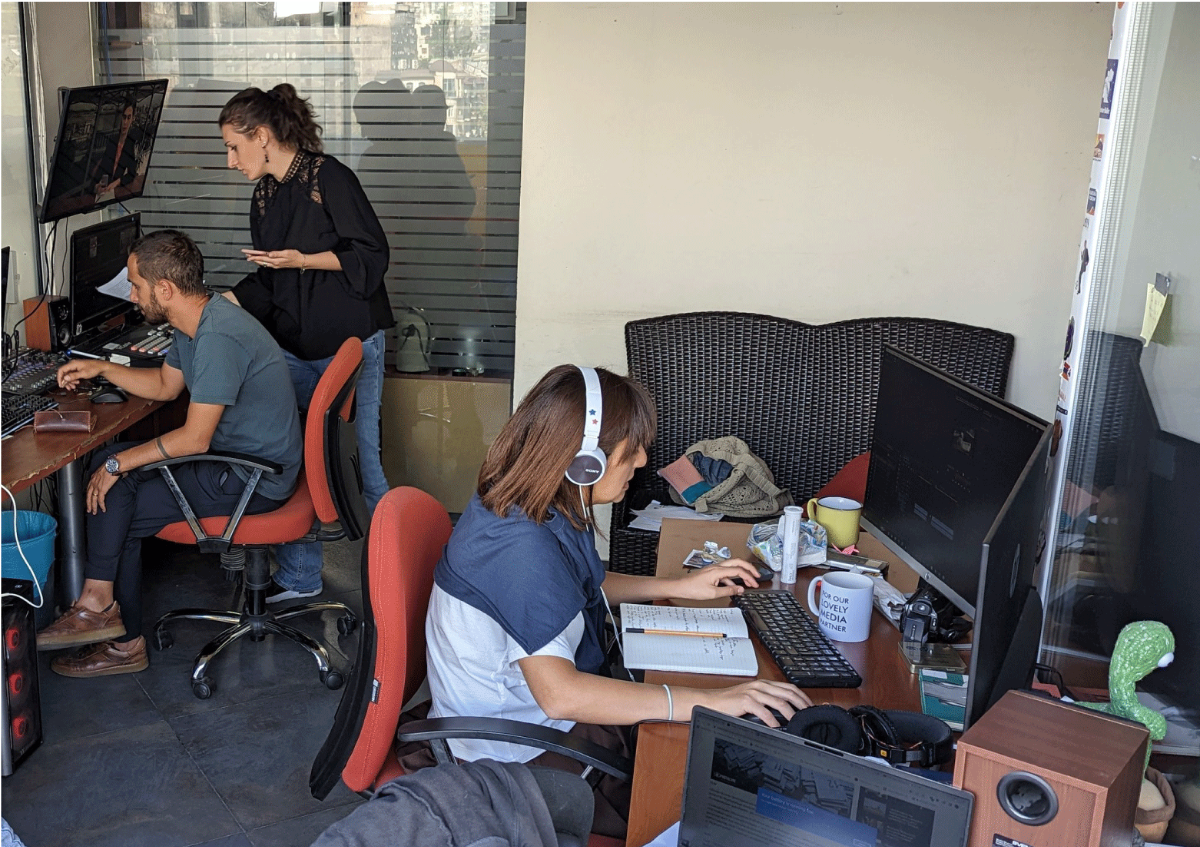
The publisher of CivilNet is a nonprofit foundation, but you also have CivilNet Studio, which offers photo and video services to others. So you have different revenue sources based on a hybrid model. Can you tell me more about how that works?
The publisher is the Civilitas Foundation. CivilNet Studio is a part of the Foundation also. We do earn some money with the CivilNet studio, but the money is directed to CivilNet’s existence. Most of the money comes from donors (+60%). Up until now, most of the donor-funded money was project funds, not core funding. We started getting some core funding from the Swedish International Development Agency, and we are going to get institutional support from Internews. But most of the support up until now was project-based.
Are you happy with this business model? What are your plans for the future?
You know, the future is uncertain, just as the region is uncertain, just as the country is uncertain. I wouldn’t say I’m happy with this model of funding. It’s not bad for the moment, but for the longer run, you don’t know if it will be sustainable. You need to rely more on your audience, on your local market. You cannot eternally rely on donor funding. That should be changed somehow in the future.
But unfortunately, the Armenian reality is that the market is too polarized, too centralized, too small, too restricted. You don’t have that many opportunities. That’s why donor funding is of paramount importance for us.
Speaking of donors, I read on your “About Us” page that you refuse to put a disclaimer below content that you publish to clarify that authors’ views do not necessarily reflect the views of donors?
When you put a disclaimer under an article, you discredit the article. The article was produced honestly to serve the public interest, to introduce the best journalism. If you put something under an article or under a video, you discredit the video. We don’t mind putting, for example, the names of our donors in our webpage, and speaking transparently about them. But we’re not going to put these disclaimers. Independence matters, but the perception of independence also matters. So you need to have both the factual independence and the perception of independence. If you have only independence but don’t have the perception of independence, it can be controversial. That’s why you can’t put disclaimers out there. You need to be as free of disclaimers as possible.