

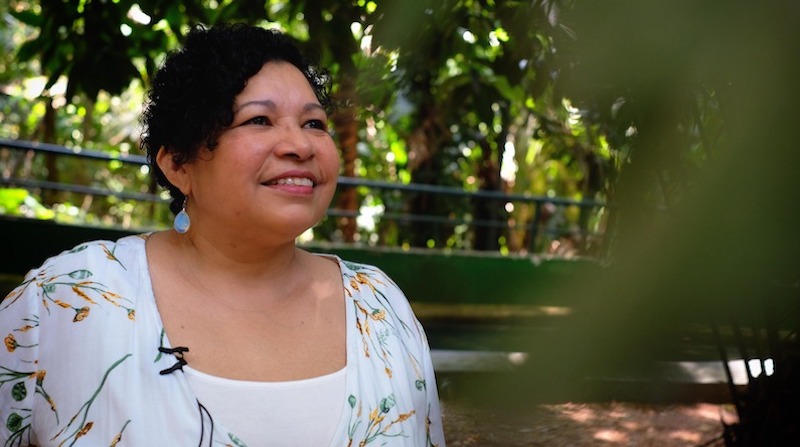
When I reached out to Agência Amazónia Real’s co-founder and executive editor Kátia Brasil for an interview, we agreed to do it via email because my Portuguese is far from fluent. When researching Kátia I became quickly impressed by her journalism career, from earning her degree while running a neighborhood newspaper to being a driving force behind so much of Agência Amazónia Real’s work. Based in Manaus, the media is made up of 24 professionals, 14 of whom are women, including reporters, photographers and video editors, spread across 10 states in Brazil. Excerpts of our exchange follow, edited for clarity.
What has changed in regards to the rights of indigenous people in the Amazon since you founded Amazônia Real?
Before Elaíze Farias and I created the Agência Amazônia Real in 2013, we worked for many years in the mainstream media, and editors were always particularly uninterested in the agenda of traditional peoples and issues in the Amazon. What sparked the most interest were conflicts involving deaths, murders of [human rights] defenders, and cases of political corruption.
There was and still is little space for indigenous peoples, quilombolas*, riverside communities, activists, environmentalists, women, children/adolescents and LGBTQI+ people. Their voices were made invisible and they also didn’t have access to quality information, which characterizes inequality in journalism.
All of this motivated us to create an independent, investigative and nonprofit journalism agency to free the people of the Amazon from the silencing that has been historically imposed by the mainstream media. It continues to this day. Recently, there was a protest lasting almost 30 days, when indigenous people from Pará occupied the headquarters of the Education Department demanding the repeal of legislation that would end in-person education in their villages. The event was not covered by the country’s main TV station.
At Amazônia Real, these people are the protagonists of their own stories and narratives. Our content is produced by local journalists and communicators—a mark of the ethnic and racial diversity of our outlet. Most of the team lives in the North, and there is a relationship of trust, respect, and transparency between the sources and the agency, which is seen as an ally in Amazonian issues. Our reports prioritize topics such as human and territorial rights violations caused by illegal mining activities, land grabbers, logging, deforestation, forest fires, the climate crisis, and social justice.
*Quilombo settlements were first established by escaped slaves in Brazil.

Has it been difficult to find financial sustainability for these issues?
The sustainability of independent, investigative, and nonprofit media has always been a challenge. To ensure unconditional independence, we do not receive public funds, or funds from individuals or legal entities involved in environmental crimes, human and territorial rights violations, slave labor, violence against children/adolescents, women, and LGBTQI+ people. At the moment, we have an active crowdfunding campaign and the goal is to raise R$100,000 in its first stage.
Our alternative was to seek funding from foundations and philanthropic institutions that support access to the media. Since 2024, such resources for independent journalism in Latin America have been drastically reduced. Many media outlets, such as Amazônia Real, are facing an unprecedented crisis.
Brazil does not have legislation that supports independent and nonprofit journalism, despite years of struggle through unions and associations. One option for sustainability would be government advertising, but there is a very serious inequality in federal government advertising. The largest media company in the country, Rede Globo, received R$177.2 million [approximately US$33 million] in advertising between 2023 and 2024 through the Secretariat of Communications (Secom). Meanwhile, independent media outlets receive nothing.
I am a member of the Articulação pela Mídia Negra (a network of black media organizations), which brings together 55 media outlets. In 2024, the network made an effort to demand a public policy in Brasilia for media outlets, but its agenda was ignored by the Lula da Silva government, which says it is fighting social inequalities. However, in the media, this inequality is absurd and persistent.
In addition to producing content, since 2015 Agência Amazônia Real has hosted debates on issues related to the Amazon region, photography exhibitions, and offered workshops for young leaders, journalism students, professionals.
How important is it for today’s journalists to create meaningful events on the intersection of journalism and other creative professions?
This dialogue with readers, students, and the general public is important precisely because it allows us to debate the values of identity and belonging to the region. In urban cities, there is racism and prejudice against indigenous peoples and quilombolas. People also lack empathy regarding issues related to violence against the population, deforestation, fires, and environmental crimes. Therefore, debates, exhibitions, and workshops were an option to encourage critical debate about the Amazon.

We live in a time when nature is gaining more rights. Ecuador has adopted a “rights of nature” law, and we see in New Zealand that rivers are being given rights to legal protection (for example, against pollution). Is this an important topic for you?
Yes, it is important, and Brazil must follow this path. When Amazônia Real was founded in 2013, the first guest columnists were environmental researchers Philip Fearnside and Paulo Artaxo, both from the Intergovernmental Panel on Climate Change (IPCC). We also invited indigenous anthropologist João Paulo Barreto and historian Patrícia Alves-Melo. In their articles, they present different ways of thinking about the Amazon for a more diverse and inclusive future, one that has equality for all and in which natural resources are not simply plundered for the wealth of a few economic groups. In 12 years, we have seen the Amazon lose much of its vegetation cover, its rivers suffer from recurrent droughts. When Fearnside said that the forest would reach the point of no return due to climate collapse, that the Amazon would be transformed into a desert, we thought it would be in the very distant future, but today, with the acceleration of forest destruction, this reality is pressing.
You created a specific training methodology for young people from the Amazon, called Jovens Cidadāos (Young Citizens). What was missing in traditional journalism teaching for you to set out on this path yourself?
The youth project was created at the request of Chief Mandeí Juma in 2014. I reported on her village. They are an indigenous group in a situation of social and cultural vulnerability due to having faced numerous massacres in the past. I have been following these people since the late 1990s and know their needs in terms of health, education and electricity. Mandeí told me that she wanted to open a social network on the internet to showcase her culture. So I created the project and, in 2018, I held the first workshop exclusively for indigenous women, in Manaus.
In the traditional press, for a long time I had no incentive to follow an indigenous group. We have always been taught to be impartial, to remain distant, but when we see lives threatened with losing their culture, we journalists have to take sides. And my side is the right to live.
The Jovens Cidadãos da Amazônia Real project encouraged indigenous people to produce their own content from within their villages and traditional communities. We held another workshop in 2019. In 2020, we created a blog and they were paid to share how they were dealing with the COVID-19 pandemic in their communities. Today, indigenous communicators and journalists are agents of many events and transformations in their territories and need to be respected and valued by the entire society.